 TopDon
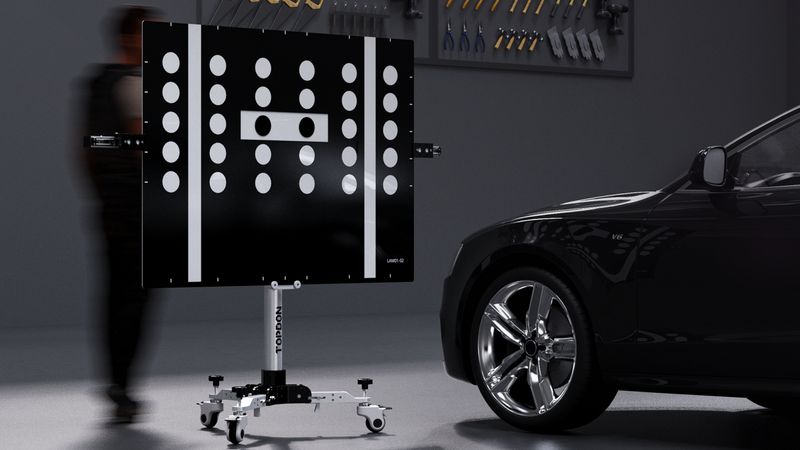
TopDon Mobile ADAS Includes Phoenix Elite Tablet Complete Shop Kit
$12,755.00
Authorized ADAS Brand
TopDon Phoenix Mobile ADAS is a compact, mobile-friendly calibration solution for shops that need to move calibration between bays or sites without a fixed frame.
Talk to an ADAS specialist 866-217-0063TopDon
TopDon
$12,755.00
 TopDon
$9,999.00
 TopDon
$8,596.00
 TopDon
$3,260.00
 TopDon
$2,799.00
Why TopDon?
A compact, mobile-friendly calibration option you can move between bays.
Pairs with TopDon Phoenix diagnostic tablets for guided procedures.
Camera and radar target coverage for common systems.
A practical fit for shops short on dedicated bay space.
If your shop is doing more glass replacements, bumper repairs, windshield swaps, and suspension work than it was five years ago, you’ve already run into the problem: nearly every one of those jobs now triggers an ADAS calibration requirement. A forward camera behind the windshield, a radar sensor behind the front emblem, a surround-view camera in the mirror or liftgate — touch the part, or the area around it, and the OEM procedure calls for recalibration before the vehicle goes back to the customer.
TopDon’s answer is the Phoenix Mobile ADAS system: a foldable, wheeled calibration frame that pairs with TopDon’s Phoenix-series diagnostic tablets. It’s aimed squarely at the shop that wants to bring calibration in-house but doesn’t have a permanent, dedicated calibration bay to give up. This page walks through what the Phoenix Mobile ADAS frame actually does, how the camera and radar calibration hardware works, the three target packages (Basic, Deluxe, and Max), how it pairs with the Phoenix tablet lineup, and who it fits.
One note up front on accuracy: TopDon sells the Phoenix Mobile ADAS in several package tiers and the exact bundled targets, prices, and tablet pairing vary by where you buy and when. Treat the figures here as a starting point and confirm the specific package and coverage for the vehicles you service before you buy.
Most fixed ADAS calibration systems are built around a heavy, floor-standing frame with a long crossbar and a rail of hanging targets. They’re accurate and rigid, but they assume you have a level, well-lit bay you can dedicate to calibration — plus the clear floor space around the vehicle that static camera procedures demand. A lot of independent collision and mechanical shops simply don’t have that bay to spare.
The Phoenix Mobile ADAS is engineered around that constraint. The frame is foldable and detachable, breaking down into three pieces — arm, column, and base — so it can be moved by one person and stored against a wall when it’s not in use. TopDon states the fully telescopic design will fit in the trunk of most cars, which is the feature mobile calibration operators and multi-location shops care about. If you do glass or calibration work at more than one building, the frame travels with the technician.
The accuracy of any static ADAS calibration comes down to one thing: getting the target board square, level, and at the correct distance and height relative to the vehicle’s thrust line — not just relative to the car’s visible bodywork. The Phoenix Mobile ADAS handles centering and leveling with a laser-based setup:
TopDon states that an experienced technician can set up the Phoenix Mobile ADAS and begin a job in about 30 minutes. That’s a realistic claim for static calibration generally — the setup and centering is the time-consuming part, and a faster, laser-assisted centering method is where a mobile frame either earns its keep or wastes your day.
Here’s the honest version of the portability pitch. A mobile frame does not eliminate the need for floor space — static camera calibrations still require a defined area in front of the vehicle, a level floor, controlled lighting, and clearance per the OEM procedure. What the mobile frame does eliminate is the need to permanently dedicate a bay to calibration. You roll the frame in, calibrate, fold it, and put the bay back to work on alignment, body, or mechanical jobs. For a shop running tight on bays, that flexibility is the whole point.
The bulk of ADAS calibration volume in a typical shop is camera work: the forward-facing camera that drives lane departure warning (LDW), lane keep assist, and forward collision warning, plus the surround-view (AVM / 360°) cameras that more and more vehicles use for parking and bird’s-eye view.
The Phoenix Mobile ADAS uses printed target boards hung on the frame’s crossbar at OEM-specified positions. The standard target set across all packages includes 24 LDW targets covering a broad range of brands. The technician selects the correct target pattern in the Phoenix tablet software, the software specifies the distance and height, and the laser-aligned frame puts the target where the OEM procedure requires it. The forward camera then “looks” at the target and the calibration routine runs.
Surround-view calibration is where the package tiers start to diverge. AVM systems use floor-laid checkerboard panels positioned around the vehicle so each camera (front, rear, both mirrors) can be calibrated to stitch a seamless overhead image. TopDon ships region-specific AVM panels — American, European, and Asian — because the panel layout the vehicle expects differs by market and OEM. The Deluxe and Max packages add these AVM panels; the Basic package does not.
The Max package extends camera-side coverage further, adding targets for Night Vision System (NVS), Rear Camera Warning (RCW), additional AVM targets, and Lidar targets. These are lower-volume calibrations for most shops, but if you service late-model luxury and EV platforms, they show up.
Camera calibration is optical — point a target, let the camera see it. Radar calibration is different, and it’s where a lot of shops underestimate what they need. Front radar (adaptive cruise control, automatic emergency braking) and corner/rear radar (blind spot monitoring, lane change assist, rear cross-traffic) require their own dedicated targets that the radar can “see” and range against.
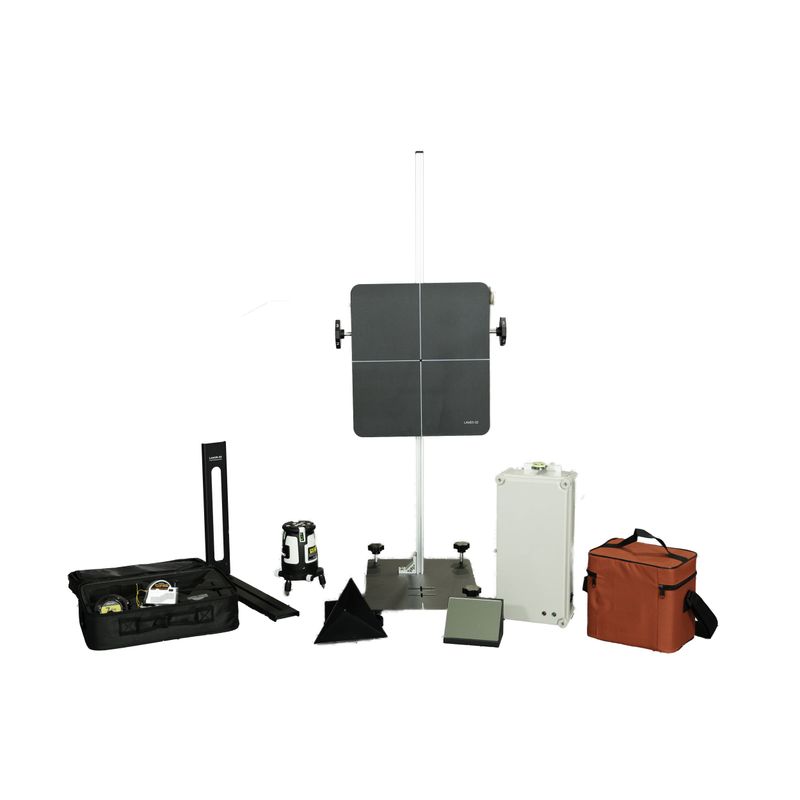
The Phoenix Mobile ADAS Max package includes TopDon’s radar calibration hardware, also sold as the ADAS Radar 3-in-1 kit:
TopDon states the radar hardware supports Adaptive Cruise Control (ACC), Blind Spot Monitoring (BSM), and Lane Change Assist (LCA) calibrations. As with all radar work, exact coverage is OEM- and model-specific — confirm the platforms you see most often are supported before committing.
Two terms you’ll see constantly in OEM procedures:
Many vehicles require both, or one or the other depending on the system. The Phoenix Mobile ADAS hardware covers the static side; the Phoenix tablet software drives both. Always follow the specific OEM procedure for the VIN in front of you — the tool tells you which type is required.
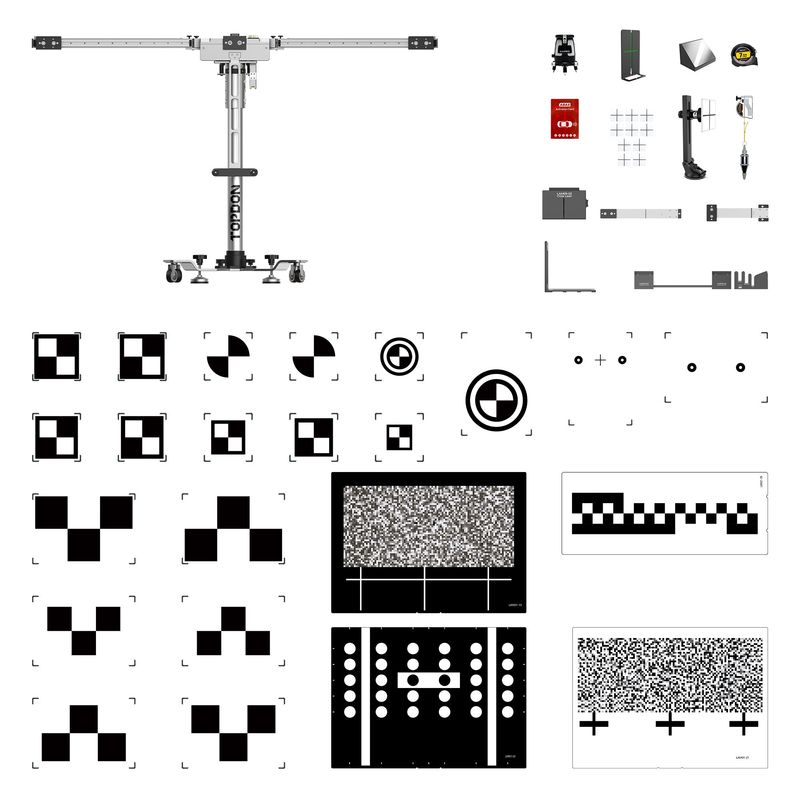
TopDon sells the Phoenix Mobile ADAS in three target package tiers built on the same frame. The frame, lasers, and core positioning accessories are common to all three; what changes is how many targets you get and which systems they cover.
| Feature / Inclusion | Basic Package | Deluxe Package | Max Package |
|---|---|---|---|
| Foldable mobile frame | Yes | Yes | Yes |
| 5-line laser + cross-line laser | Yes | Yes | Yes |
| Core accessories (reflector, auxiliary mirror, L-bracket, plumb bob, extension rods, target storage) | Yes | Yes | Yes |
| 24 LDW / forward-camera targets | Yes | Yes | Yes |
| AVM 360° panels (US / Euro / Asian) | No | Yes | Yes |
| Night Vision (NVS) targets | No | No | Yes |
| Rear Camera Warning (RCW) targets | No | No | Yes |
| Lidar targets | No | No | Yes |
| Radar: cone target (LAM05-02), corner reflector (LAC05-03), Doppler simulator (LAC05-04) | No | No | Yes |
| Best fit | Glass/LDW-focused shops entering ADAS | Shops adding surround-view coverage | Full camera + radar calibration, one box |
| Typical list price (confirm current) | ~$8,600 | Between Basic and Max | ~$28,000 |
Prices shown are representative list figures seen at TopDon USA and distributors and change frequently — confirm the current price and exact package contents before purchase.
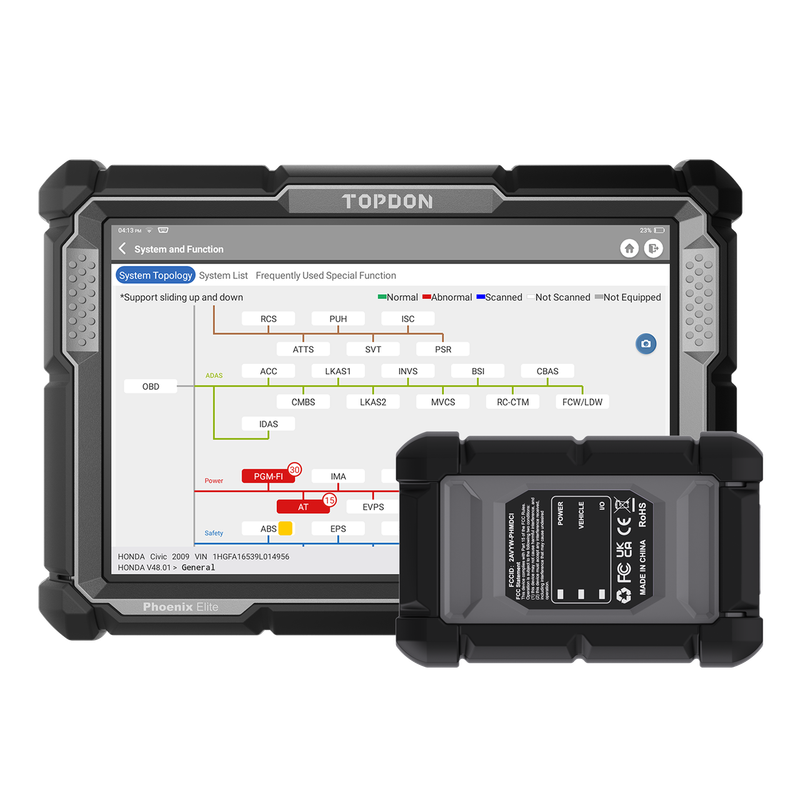
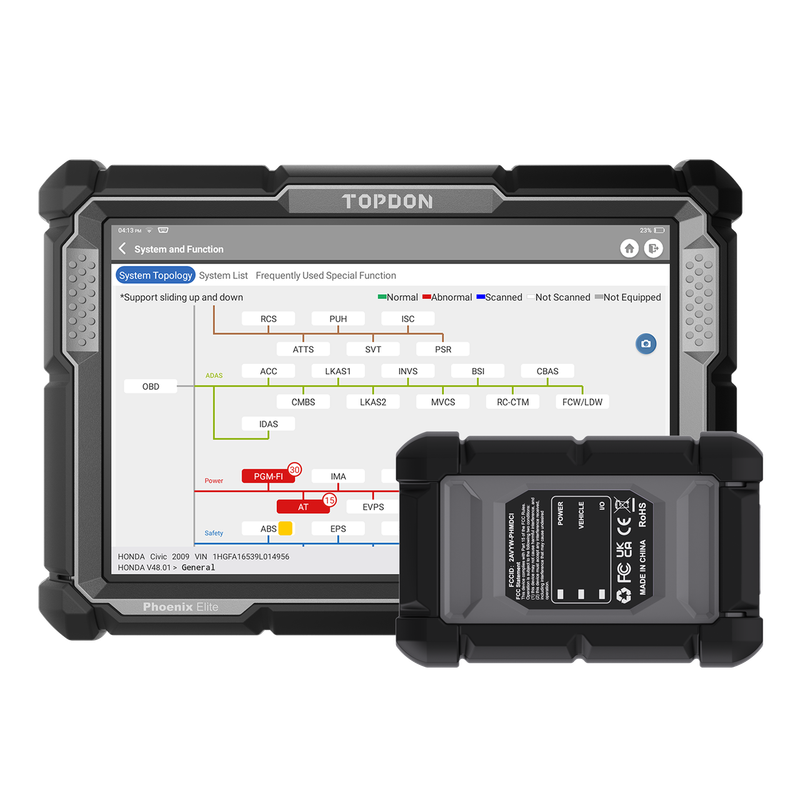
The Phoenix Mobile ADAS frame is the hardware; the brains are TopDon’s Phoenix-series diagnostic tablet. The tablet runs the calibration software, tells you which targets and distances to use, performs the pre- and post-scan, and executes the calibration command to the vehicle. TopDon offers ADAS as a software add-on across most of the Phoenix tablet range, so you can build the calibration station on the tablet you already own or buy.
Per TopDon, the ADAS software upgrade can be added to: Phoenix & Phoenix Lite, Phoenix Nano, Phoenix Lite 3, Phoenix Plus & Phoenix Plus 2, Phoenix Pro, Phoenix XLink, Phoenix Elite, Phoenix Smart, Phoenix Remote, and Phoenix Max. In other words, the frame isn’t locked to one tablet — it pairs with the Phoenix tablet that matches your diagnostic needs.
The Phoenix Max is TopDon’s flagship tablet and the natural partner for the Max ADAS package. Notable specs from TopDon and distributors:
The combination of programming-capable diagnostics, an oscilloscope, and ADAS calibration in one tablet is what makes the Phoenix Max attractive to a shop that wants a single platform for everything — diagnose, program, calibrate.
If you don’t need the 13.3″ Max, the Phoenix Elite is an OE-level scan tool that also accepts the ADAS software upgrade and pairs with the Phoenix ADAS frame. TopDon’s framing is that you download the ADAS upgrade, connect the frame, and “turn your Phoenix Elite into a calibration station.” The same logic applies down the Phoenix line — buy the diagnostic capability you need, then add ADAS. Note that ADAS calibration always requires the physical frame and targets in addition to the software; the tablet alone cannot calibrate.
TopDon states the Phoenix Mobile ADAS supports 40+ vehicle brands across US, European, and Asian markets, and covers the major ADAS function families:
As with every ADAS calibration platform, “supported” means the targets and procedures exist for that system on covered models — it does not guarantee every model-year-trim combination. Software updates expand coverage over time, which is why an active update subscription on the Phoenix tablet matters. Before buying, give a distributor your three or four most common vehicle platforms and confirm they’re covered.
The Phoenix Mobile ADAS makes the most sense for:
TopDon’s Phoenix Mobile ADAS is a practical, mid-priced calibration platform built around portability. The foldable wheeled frame, laser centering, and tiered target packages let a shop start with high-volume forward-camera work at a relatively low entry price and grow into surround-view and full radar calibration as the business case develops. Paired with a Phoenix tablet — Elite for OE-level diagnostics or Max for an all-in-one diagnose/program/calibrate platform — it’s a sensible way for a space-constrained shop to stop subletting calibrations and keep the work, and the margin, in-house.
The right package depends entirely on your job mix and the vehicles you see most. If you want help matching the Basic, Deluxe, or Max package and the correct Phoenix tablet to your shop’s actual workload — and confirming coverage for your common platforms — call our team at 866-217-0063 and we’ll walk through it with you.
Questions
It is built for mobility — easier to move and store than a large fixed frame, which suits shops that calibrate across multiple bays or locations.
Coverage depends on the targets and software; we will confirm for the makes you service.
Both are supported depending on the vehicle.
Yes — our specialists help with selection and setup.
Learn More
Talk to an ADAS specialist — we'll match the right TopDon equipment to your vehicles, bay space, and workflow.