 Atlas
Atlas
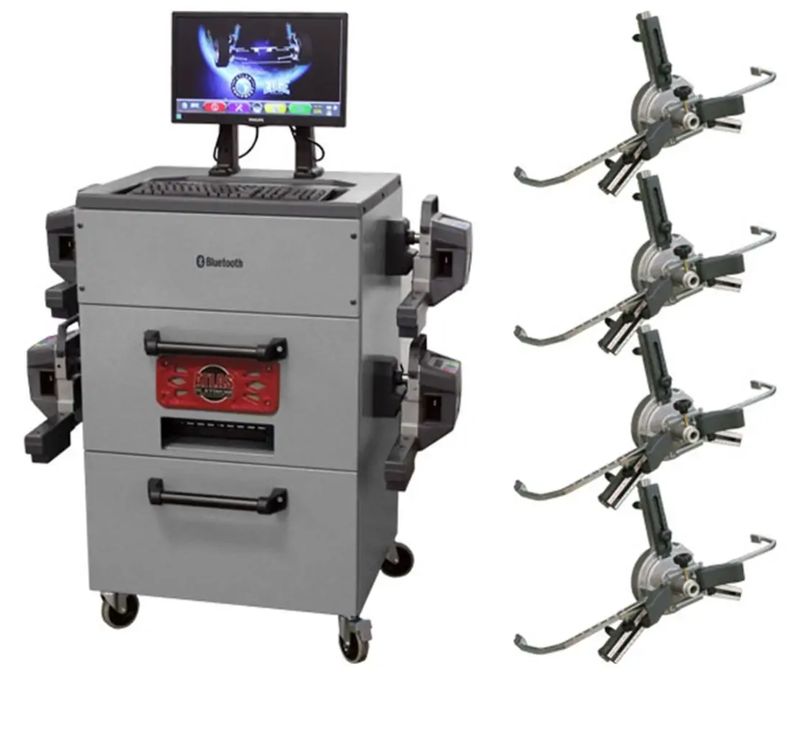
Atlas Automotive Equipment Atlas Platinum 601 Alignment Machine w/ 3-Point Clamps - ATEAP-PWA601
$15,988.00
Authorized ADAS Brand
Atlas brings ADAS-capable wheel alignment equipment to the shop, supporting the alignment-plus-calibration workflow that many modern safety systems require.
Talk to an ADAS specialist 866-217-0063Atlas
Atlas
$15,988.00
 Atlas
Atlas
$14,199.00
 Atlas
Atlas
$12,999.00
Why Atlas?
Combines wheel alignment with ADAS-capable workflows in the shop.
Supports the alignment-then-calibration sequence many vehicles require.
Durable, shop-ready equipment built for everyday throughput.
A practical choice for shops adding ADAS alongside alignment work.
If your shop is doing modern collision or mechanical work, you have already run into the wall: a forward camera or front radar that throws a “calibration required” code, and an OEM procedure that tells you the wheel alignment must be correct before you touch the sensor. Atlas Automotive Equipment built its Edge and Platinum aligner lines to sit at the front of that workflow — measure the vehicle’s geometry, confirm thrust line and alignment, then feed an ADAS calibration package that targets the cameras, radar, and other sensors that depend on that geometry being right.
This page walks through what Atlas actually sells, how the alignment-plus-calibration workflow is supposed to run, what comes in the box at each tier, and which shop each configuration suits. Atlas builds its 3D aligners around hardware from established European manufacturers (Ravaglioli-sourced sensor technology appears across the Edge TD2.0 line), and its ADAS calibration capability is delivered through frame-and-target calibration packages. Where a spec varies by package or distributor, we say so plainly — confirm the exact configuration for your vehicle mix before you buy.
Before getting into hardware, it’s worth being precise about why an aligner belongs in the ADAS conversation at all. This is the single most misunderstood part of ADAS work, and it’s the reason Atlas pairs its aligners with calibration packages instead of selling the calibration frame alone.
When you calibrate a forward-facing camera or a front radar, the procedure is establishing where the vehicle’s “straight ahead” actually is. The sensor learns its zero point relative to the vehicle’s thrust line and centerline — the geometric direction the vehicle actually travels, defined by the rear axle. Lane-keep assist, adaptive cruise, automatic emergency braking, and lane-departure warning all interpret the road relative to that reference. If the geometry feeding the calibration is wrong, every downstream decision the system makes is built on a bad assumption.
The industry data here is sobering and worth quoting to any customer who questions the alignment step. According to collision-industry reporting, a forward radar module that is just one degree off from the true direction of travel will be off target by more than five feet at 100 yards. Even a half-degree alignment discrepancy can cause cameras and radar to miscalculate road position, producing symptoms like ghost braking, late lane-keep intervention, or a system that simply won’t calibrate. The sensor is only as accurate as the geometry it was referenced to.
Most OEM calibration procedures require a wheel alignment to be verified — and corrected if needed — before the ADAS calibration is performed, because the thrust angle may have changed since the vehicle left the factory or since whatever event brought it into your shop. A vehicle that has been in a collision, had suspension work, or simply accumulated wear can have a thrust angle that no longer matches the body centerline. Calibrating a camera to a crooked-tracking vehicle bakes that error in permanently.
An Atlas aligner handles steps 2 and 3 directly; the ADAS calibration package handles steps 4 and 5. The whole point of buying them together is to do all of this in one bay, without rolling the car to a second shop and re-introducing setup error.
Atlas splits its 3D imaging aligners into two families. Both use multi-camera optical sensor heads on the wheel clamps and read alignment angles to a 3D imaging system. The practical differences come down to cabinetry, sensor/clamp technology, and how the system communicates.
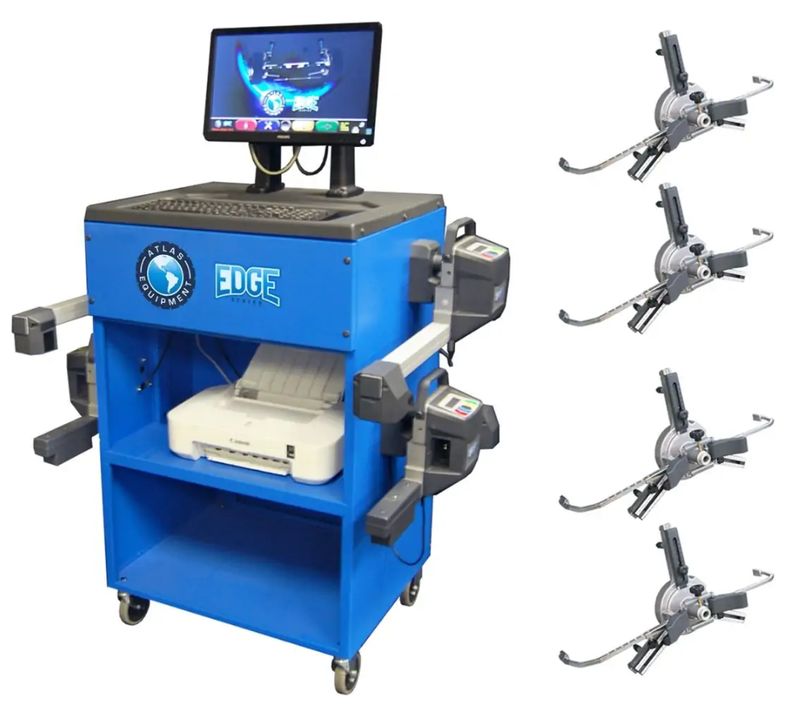
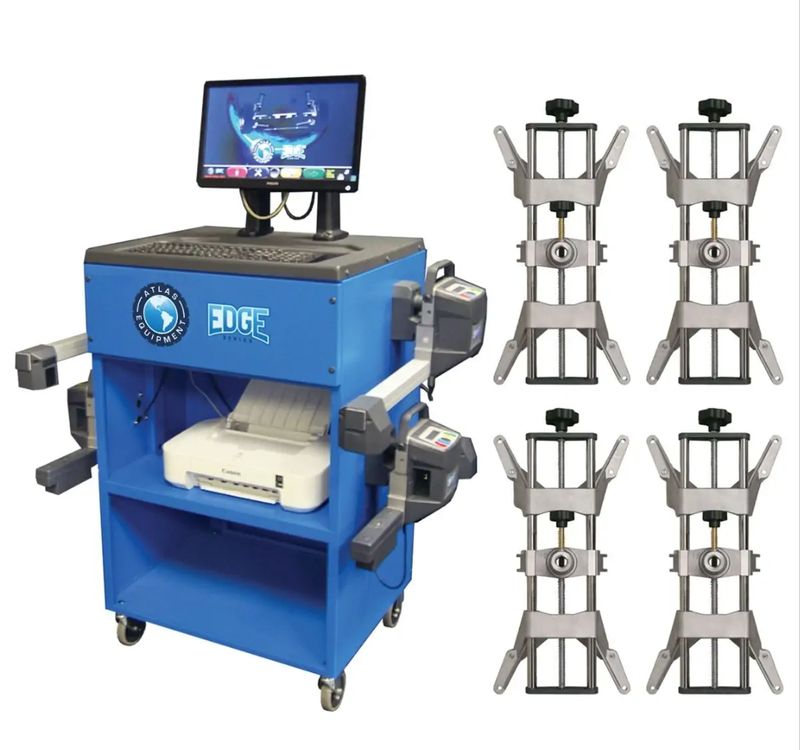
The Edge line is the workhorse tier. The Edge 501 is an 8-camera Bluetooth system where the sensor heads “look at each other” across the rear of the vehicle, establishing a closed measured field around all four wheels. Each 8CCD sensor head doubles as a fully functional remote control. Because the system creates a closed 360-degree measured field, it can perform additional collision measurements — rear-wheel setback calculations and frame/unibody checks — which is directly useful in a collision shop that needs to confirm structural straightness before calibration. The Edge 501 typically ships with a lithium-battery cabinet, color printer, LCD monitor, keyboard, and 4-point clamps with turntables. Pricing on the Edge 501 has been listed around $9,899, though confirm current pricing with the distributor.
The Edge TD2.0 WiFi is the more advanced Edge configuration. It uses newer wireless sensor heads described as stronger, more compact, and highly accurate, running on ultra-fast WiFi plus Bluetooth. Key practical features:
The TD2.0 is sold in tiered packages (commonly Deluxe and Premium). The Deluxe package has been listed around $17,995 and ships with 4-point STDA46-series non-runout clamps, charging panels, wall storage pegs, two-post lift height adapters, alloy turning plates, steering and brake locks, and the TEQ-LINK report application. The Premium package steps up to 3-point STDA96-series non-runout FastClamps and adds a VIN scan tool for vehicle selection and the calibration software/report tooling. Exact contents vary by package — confirm the clamp type and whether calibration software is bundled for the package you’re quoting.
The Platinum line is the premium tier, with upgraded cabinetry and the most capable sensor packages. The Platinum 601 is an 8-camera optical alignment machine with 3-point FastClamp non-runout wheel clamps (10″–24″) and Bluetooth wireless data transmission. Like the Edge 501, its 8-camera closed 360-degree measured field lets it monitor sensor-head calibration status and tell the operator if a head itself needs recalibration. It ships with deluxe cabinetry, color printer, LCD monitor, and keyboard. Atlas describes the Platinum 601 as built on aligner technology from a premier European manufacturer, emphasizing measurement speed, accuracy, and wireless reliability.
Crucially for this page, the Platinum 601’s premium options include an ADAS Software Upgrade and an ADAS Standard Calibration Package — this is how Atlas turns the aligner into the front end of an ADAS calibration cell. There is also the PWA-3D, a fully wireless 3D aligner that Atlas lists as ADAS compatible. Specific list pricing on the Platinum 601 and PWA-3D varies by distributor and configuration; the ADAS upgrade and calibration package are priced separately. Confirm both the base aligner price and the ADAS package price with the seller.
It’s important to be clear about what “ADAS capable” means on an Atlas aligner. The aligner itself measures geometry; the actual sensor calibration is done with a separate calibration frame and target package. On the Atlas ADAS side, these calibration packages are built around an Autel-based frame, target boards, patterns, and ADAS software — the same target-and-frame approach used across the broader Autel IA-series ecosystem. That’s a strength, not a compromise: it means the calibration hardware is a known, widely supported platform with broad vehicle coverage, mounted in front of the Atlas aligner that already nailed the geometry.
Because Atlas’s calibration packages use a frame that squares to the vehicle and target boards positioned by measurement, the alignment data and the calibration setup work together: you correct thrust angle on the aligner, then position the target board to the corrected centerline. That continuity is the entire value proposition.
The Atlas/Autel-based packages handle static calibrations (targets positioned in the bay) and support dynamic calibrations (a scan-tool-guided road drive) where the OEM requires them. Many vehicles require one or the other; some require both. The calibration frame and targets cover the static side; the scan tool drives the dynamic side. Confirm which procedures your common vehicles use — it affects whether the static-target package alone is enough.
A complete alignment-plus-ADAS cell is several line items, and it’s worth being honest about that so you don’t under-budget.
Static ADAS calibration has real space and surface requirements: a level floor, controlled lighting, clearance around the vehicle for the target board at the OEM-specified distance, and enough room behind/around the vehicle for radar and around-view procedures. A portable WiFi aligner like the TD2.0 helps in tight shops, but the calibration target distances are dictated by the OEM, not the equipment. Measure your bay before you commit.
| Model | Series / Tier | Sensor / Camera System | Communication | Clamps | ADAS Path | Best For |
|---|---|---|---|---|---|---|
| Edge 501 | Edge (value) | 8-camera optical, closed 360° field; 8CCD heads | Bluetooth wireless | 4-point with turntables | ADAS-ready; pair with calibration package | Shops wanting collision measurement + alignment at a lower entry price |
| Edge TD2.0 WiFi | Edge (advanced, portable) | Advanced compact WiFi wireless heads | WiFi + Bluetooth, PC-free tablet control | 4-point (Deluxe) / 3-point FastClamp (Premium) | ADAS-ready; No-Push/No-Roll; pair with calibration package | Tight bays, multi-lift flexibility, mobile/portable operations |
| Platinum 601 | Platinum (premium) | 8-camera optical, closed 360° field, sensor-status monitoring | Bluetooth wireless | 3-point FastClamp non-runout (10″–24″) | ADAS Software Upgrade + ADAS Standard Calibration Package (explicit options) | High-volume shops wanting a premium fixed alignment + ADAS cell |
| Platinum PWA-3D | Platinum (premium, wireless) | 3D imaging, fully wireless | Wireless | Varies by configuration | ADAS compatible; pair with calibration package | Shops wanting a fully wireless premium 3D aligner |
Specs reflect commonly listed configurations and may vary by package and distributor. Confirm clamp type, included software, and ADAS package contents for the exact unit you are quoting.
| Package Tier | Core Hardware | Systems Covered | Typical Buyer |
|---|---|---|---|
| LDW / Camera (e.g., LDW20-style) | Stand, frame, camera targets, patterns, ADAS software | Front camera / lane-departure warning — common static camera calibrations | Glass-replacement-heavy shops; entry into ADAS |
| Standard Frame “All Systems” | Frame, full target/pattern set, radar plates, calibration box, corner reflector | Camera, radar (ACC), lidar, night vision, AVM/around-view, RCW, blind spot | Full-service collision shops wanting broad in-house coverage |
| CV (Commercial Vehicle) Frame | CV-scaled frame, clamp lasers, digital tape measures, wheel dials | LDW, BSD, RCW, AVM on Class 1–3 commercial vehicles | Fleet and commercial-vehicle service operations |
Exact target sets, supported makes, and software coverage vary — verify against your common vehicle mix before purchase.
If you’re a body shop currently subl”)letting calibrations and want to bring the work in, the priority is closing the loop between structural/alignment correction and sensor calibration. The Edge 501 or Platinum 601 make sense here because their closed 360-degree measured field also gives you collision/setback measurement — you can confirm the unibody is straight, correct the alignment, and then calibrate, all referenced to the same geometry. Pair either with a Standard Frame “All Systems” calibration package so you cover both camera and radar.
A general repair shop doing alignments daily and occasional camera recalibrations after glass or suspension work may not need the full radar package on day one. An Edge TD2.0 aligner with an LDW/camera calibration pack covers the most common, most profitable static camera jobs, and you can expand to a radar-capable package later as volume justifies it.
The Edge TD2.0 WiFi is the standout here: PC-free tablet control, No-Push/No-Roll measurement, wall-stored components, and compatibility with multiple lift types. It lets a shop run alignment in a bay that wasn’t purpose-built as an alignment rack. Remember, though, that the calibration target distances are still OEM-dictated, so confirm you have the floor space for the static procedures you intend to perform.
For a shop committing to a permanent alignment-plus-ADAS bay, the Platinum 601 with the ADAS Software Upgrade and Standard Calibration Package gives you a premium fixed cell: deluxe cabinetry, 3-point non-runout FastClamps for fast accurate setup, and an explicit factory path to ADAS calibration rather than a bolt-on afterthought.
Atlas’s value in the ADAS space isn’t that it reinvented calibration — it’s that it puts a capable, fairly priced 3D aligner at the front of the workflow and feeds a proven frame-and-target calibration package behind it. For a shop, that means correcting thrust line and alignment and calibrating the sensors that depend on them in the same bay, referenced to the same geometry, without rolling the vehicle to a second location and re-introducing error. The Edge series gives you an accessible, flexible entry (especially the portable TD2.0), while the Platinum 601 gives you a premium fixed cell with an explicit ADAS upgrade path. The right choice comes down to your vehicle mix, your bay space, and how much radar/all-systems coverage you need in-house.
If you want help matching an Atlas Edge or Platinum aligner to the right ADAS calibration package for the vehicles you actually service — and getting the scan-tool and bay-space details right before you buy — call us at 866-217-0063. We’ll walk through your specific workflow and put together a configuration that does alignment and calibration in one bay, correctly.
Questions
Many ADAS calibrations depend on accurate wheel alignment and thrust line first. Atlas ADAS-capable aligners support that alignment-plus-calibration workflow.
Atlas focuses on the alignment side of the workflow; we will help you pair it with the right calibration targets and software for your vehicles.
Yes — our specialists will match Atlas equipment to your bay and workflow.
Learn More
Talk to an ADAS specialist — we'll match the right Atlas equipment to your vehicles, bay space, and workflow.