 Bosch
Bosch
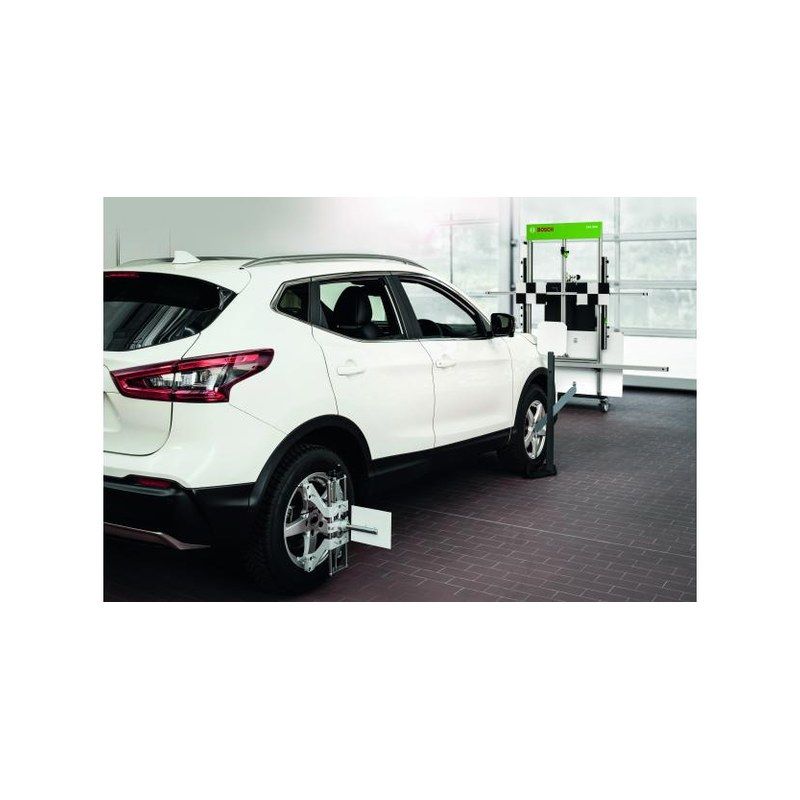
Bosch ADAS Bundle
$40,741.36
Authorized ADAS Brand
Bosch DAS 3000 is a precision ADAS calibration platform backed by one of the most trusted names in automotive equipment, with camera and radar target coverage for a wide range of vehicles.
Talk to an ADAS specialist 866-217-0063Bosch
Bosch
$40,741.36
 Bosch
Bosch
$39,498.98
 Bosch
Bosch
$32,710.43
 Bosch
Bosch
$32,710.43
 Bosch
Bosch
$7,524.99
Why Bosch?
Bosch DAS 3000 is calibration hardware engineered by an OEM-tier manufacturer.
Camera and radar target coverage across a broad range of makes.
Backed by Bosch deep OEM relationships and diagnostic heritage.
Pairs with Bosch software for guided, repeatable procedures.
Robert Bosch sits in a position no other ADAS aftermarket tool maker can claim: the company designs and manufactures the actual cameras, radar sensors, and control modules that go into the vehicles you’re calibrating. When a Toyota, VW, or GM camera module needs recalibration after a windshield replacement, there’s a strong chance Bosch engineered that sensor in the first place. That OEM-supplier relationship is the foundation of the DAS 3000 calibration system, and it’s the single most important thing to understand before you spend money on an ADAS rig.
This page covers what the DAS 3000 actually is, the S20 frame and its working-envelope specifications, the camera and radar target system (the CTA and SCT boards plus the CTA 110 Doppler simulator), the Bosch ADAS Positioning (BAP) thrust-line measurement system, how ESI[tronic] drives static and dynamic procedures, vehicle coverage, and the practical question every shop owner asks: does a Bosch rig fit the way my shop actually works? We’ve pulled specifications from Bosch’s official aftermarket and diagnostics sites and from authorized distributors. Where a number varies by package or region, we say so rather than guessing.
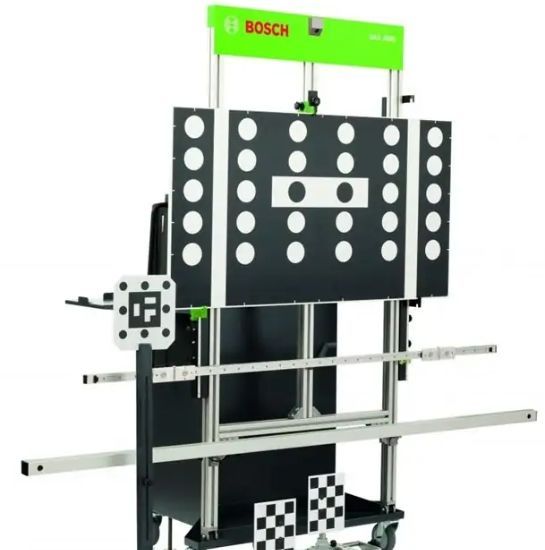
The DAS 3000 is a fixed-frame, computer-vision-positioned ADAS calibration system. It is not a folding mobile cart you wheel between bays, and it is not a wheel aligner. It’s a free-standing trolley frame that holds camera targets and radar reflectors at precise, software-verified positions in front of (and, with accessories, beside and behind) the vehicle. The system measures its own position relative to the car’s driving axis using vision sensors, then tells you exactly where to place each target for the OEM-specified static calibration.
Bosch markets the current generation under the DAS 3000 S20 name (the “S20” refers to the frame generation that aligns to the drive axle). In the U.S. market you’ll most often see it sold as the DAS 3000-3 ADAS Calibration Solution and the ADAS Master Recalibration Solution (model DAS3000-1 / SKU BODAS3000-1). The system is built to be modular and upgradeable, which matters because OEM sensor requirements change every model year.
The working envelope is where a lot of shops get caught out. ADAS targets only produce a valid calibration if they sit within the frame’s mechanical adjustment range and within the OEM-specified distance from the sensor. Here are the DAS 3000 S20 specifications as published by Bosch’s aftermarket site. Treat these as the geometry your bay has to accommodate.
| Specification | DAS 3000 S20 | What It Means for the Shop |
|---|---|---|
| Overall dimensions (H × W × D) | 2,090 × 2,030 × 730 mm | Roughly 6.9 ft tall, 6.7 ft wide; needs a tall, open bay |
| Net weight | ~120 kg (~265 lb) | Rolls on casters but is not a one-hand lift |
| Vehicle track width accommodated | 1,650 – 2,200 mm | Covers passenger cars through full-size trucks/vans |
| Distance measurement range (BAP) | 0.4 – 6 m | Vision positioning works from ~16 in to ~20 ft |
| Thrust-line / centerline detection | up to 8 m | Establishes the driving axis, not just the body centerline |
| Radar vertical mounting range | 260 – 1,000 mm | Reaches low bumper radar through tall truck grilles |
| Radar lateral offset | +/- 750 mm | Handles off-center front radar placement |
| Radar 3-point calibration | -2° / 0° / +2° | Verifies radar aim at three reference angles |
| Camera measurement bar height | 700 – 1,850 mm | Sets target height for sedans through high-roof vans |
| Target carriage lateral travel | +/- 800 mm | Centers the board on the camera’s optical axis |
| Wheel clamp range | 13″ – 22″ (opt. 23″ – 28″) | Covers most wheels; verify oversized truck/EV wheels |
A practical note on floor space: Bosch lists a minimum clear floor area of roughly 8 × 3.5 m (about 26 × 11.5 ft) for the Doppler-simulator workflow, and a similarly generous, flat, well-lit area for the camera/radar static work. The floor needs to be reasonably level — vision positioning corrects for vehicle pose, but it can’t fix a sloped, cluttered bay. If your only open space doubles as a parking area between jobs, plan accordingly.
The Bosch ADAS Positioning system is the part that separates the DAS 3000 from string-line and laser-only rigs. BAP uses industrial vision sensors mounted on the frame to read the vehicle and measure the fixture’s distance and angle relative to it. Critically, BAP establishes the thrust line (driving axis) — the direction the rear axle actually points the car — not merely the body centerline. ADAS sensors are aimed relative to how the vehicle tracks down the road, so calibrating to the body centerline of a car with a rear-axle offset would put the sensor’s aim off in the real world even if the bench numbers looked fine.
BAP supports 1-point, 2-point, and sequential calibrations, which matters because different OEMs specify different setups — some want a single centered board, others want the board positioned at multiple lateral points in sequence. The software walks the technician to each position and confirms the fixture is within tolerance before the calibration is allowed to proceed. That digital traceability is also what produces the documentation a shop needs to defend the repair.
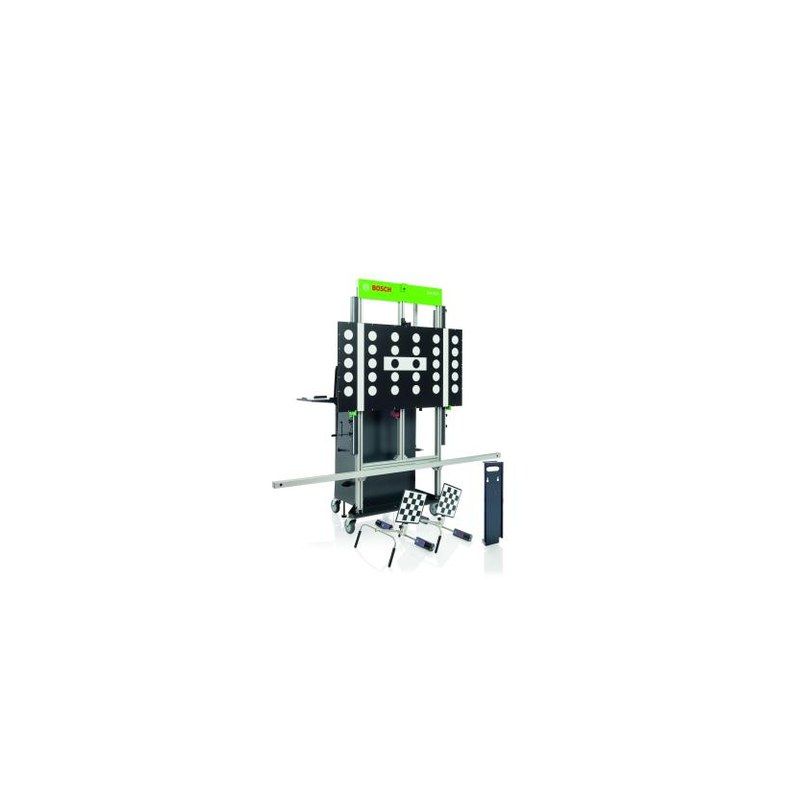
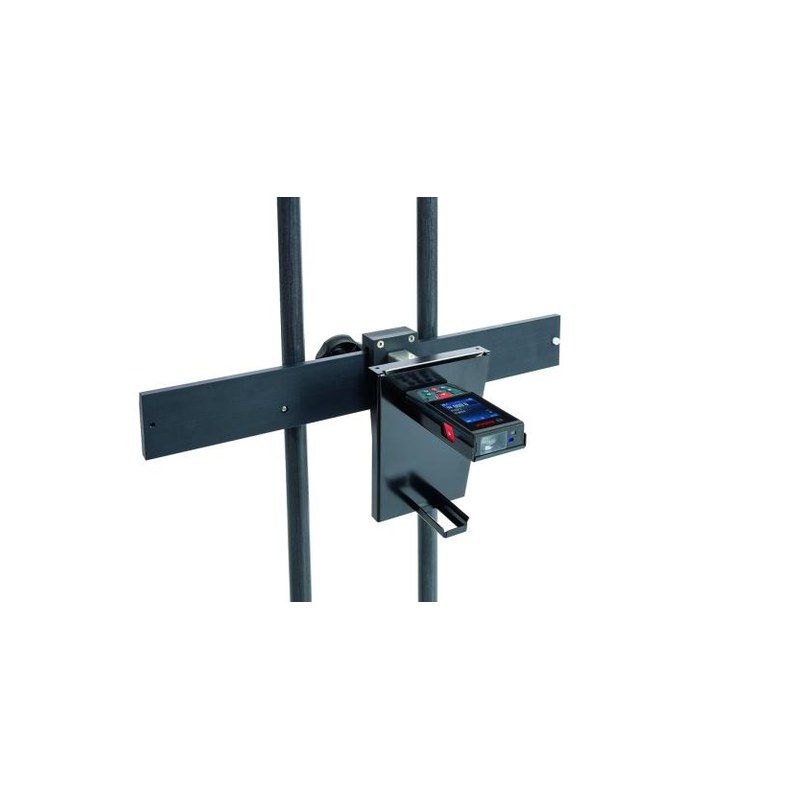
Static camera calibration requires the exact OEM target pattern at the exact OEM distance and height. Bosch ships the DAS 3000 with a kit of printed target boards, designated in the CTA series, and stores them in an integrated box on the frame so technicians aren’t hunting for the right board mid-job. The published U.S. kit includes on the order of 14–18 boards depending on package and revision. Representative boards include:
The dual-purpose design is worth calling out. The VW/Audi board (the CTA 300-2 / “dual-purpose VW camera board”) functions both as a camera target and as a universal OEM radar reflector carrier — you mount it horizontally for camera calibration and reorient it for radar work. That cuts down on the number of separate pieces you store and swap.
For front, corner, and rear radar that calibrate against a passive reflector, Bosch supplies a fiberglass universal cone reflector with laser alignment — sold as the SCT 815 / CTA 120 depending on documentation. The cone shape and laser sighting let the technician aim the reflector precisely along the radar’s expected boresight. The frame’s radar 3-point calibration (-2°/0°/+2°) then lets ESI[tronic] verify the sensor reads the reflector correctly across its angular field.
For 360° camera (AVM/surround-view) calibration, Bosch includes floor-mat targets in the SCT/CTA 500 series, with OEM-specific patterns for VAG (CTA 500/501), Ford (CTA 520), GM (CTA 531), and Honda (CTA 542), among others. These are laid on the floor in the OEM pattern around the vehicle so the surround-view system can stitch its image correctly.
Some rear and side radar systems can’t be calibrated against a passive reflector alone — they need an active, moving-target signature to verify angle measurement and to satisfy lane-change-assist, blind-spot, and cross-traffic functions. That’s the job of the CTA 110 Doppler Simulator. It’s an active electronic device (24 V DC, 1.5 A) that generates a simulated Doppler return so the vehicle’s rear/corner radar sees a valid moving signal during calibration.
Per Bosch, the CTA 110 is used for rear and side radar calibration on VW / Audi / Porsche and Mazda vehicles. It mounts to the DAS 3000 and is positioned by the same BAP vision system, with an adjustable height of roughly 500–1,000 mm (19.7″–39.4″) and lateral positioning along the measurement bar. The CTA 110 is generally a separate accessory rather than standard kit content — if your work includes a lot of VAG or Mazda rear-radar calibration, budget for it specifically.
Hardware positions the targets; software runs the calibration. On the DAS 3000, that software is Bosch ESI[tronic] (the current generation is ESI[tronic] Evolution), driving a Bosch KTS/ADS diagnostic interface, often combined with the ADAS One Solution positioning software. ESI[tronic] is also the same diagnostic platform Bosch shops use for general ECU diagnosis, so the ADAS workflow lives inside a tool many techs already know.
The important distinction for every ADAS job is static versus dynamic — and ESI[tronic]’s genuine value here is that it tells you which one the specific vehicle needs and walks you through it.
Static calibration is done in the bay with the vehicle stationary. It requires the DAS 3000 frame, the correct CTA target board (for cameras) or reflector / Doppler simulator (for radar), positioned at the OEM distance and height. The vehicle sits on a flat surface, BAP establishes the thrust line, the software directs target placement, and the diagnostic tool triggers the sensor’s learn routine. This is the workflow the DAS 3000 is built around.
Dynamic (drive-cycle) calibration is performed by driving the vehicle on a straight road, above a minimum speed, with clear lane markings and minimal turns, while the diagnostic tool runs the learn procedure. Dynamic calibration needs only ESI[tronic] plus the KTS/ADS scan tool — no frame — but it depends on having suitable roads and weather. Many vehicles require both: a static setup in the bay followed by a confirming drive cycle.
| Aspect | Static Calibration | Dynamic Calibration |
|---|---|---|
| Where | In the bay, vehicle stationary | On the road, vehicle driven |
| Equipment needed | DAS 3000 + targets + ESI[tronic] + KTS/ADS | ESI[tronic] + KTS/ADS scan tool |
| Controls / repeatability | High — controlled, documented setup | Variable — depends on road, traffic, weather |
| Typical use | Most front cameras, many radars | Some cameras (e.g., certain BMW cameras), confirmation runs |
| Documentation | Full position + result report | Pass/fail result, drive parameters |
ESI[tronic] varies the procedure by manufacturer. As Bosch’s own training material notes, BMW commonly uses dynamic for cameras and static for radar, while Volkswagen leans on static — so a generic “one procedure fits all” assumption will get you a failed or invalid calibration. On completion, ESI[tronic] lets you save a calibration report, which is the record that documents you followed OEM procedure. For shops dealing with insurers and liability, that report isn’t a nice-to-have; it’s the proof the work was done correctly.
Because Bosch is an OEM sensor supplier, coverage is broad and runs deep on the brands Bosch supplies. The published U.S. kits target recalibration across Kia, Hyundai, Mazda, Toyota/Lexus, Honda, Nissan, Mitsubishi, Subaru, Daimler/Mercedes, Infiniti, Volkswagen/Audi/Porsche, Ford, and GM, with surround-view support for GM, Ford, Honda, Mitsubishi, Nissan, and the VAG group.
Two honest caveats. First, exact coverage depends on your ESI[tronic] subscription level and on which target boards and accessories (notably the CTA 110 Doppler simulator and CTA 150 Audi LiDAR board kit) are in your package. Second, ADAS coverage is a moving target — every new model year brings new sensors and procedures. Confirm coverage for your specific vehicle mix and brands with Bosch or your distributor before buying, rather than assuming the brochure list covers your exact applications.
The reason to consider Bosch over a lower-cost rig usually comes down to one thing: Bosch builds the sensors. The calibration logic, the angular tolerances, and the procedures the DAS 3000 enforces come from the same engineering organization that designed many of the cameras and radars in service. Bosch is also co-developing next-generation sensors with OEMs, which is why the system is built modular and upgradeable. For a high-volume collision shop calibrating the brands Bosch supplies — particularly VAG and many Asian makes — that alignment between sensor maker and calibration tool is a real, defensible advantage, not marketing.
Bosch sells the DAS 3000 in tiers that differ mainly by how many target boards, which accessories, and which scan tool are bundled. The names and exact contents vary by region and distributor, so use the table below as a structural guide and confirm the current bill of materials before purchase.
| Configuration | Typical Contents | Best Fit |
|---|---|---|
| DAS 3000 base / Calibration Solution (DAS3000-3) | S20 frame with BAP, core CTA camera boards, universal radar reflector, surround-view mats, requires ESI[tronic] + ADS scan tool (may be sold separately) | Shops that already run Bosch diagnostics and want the calibration hardware |
| ADAS Master Recalibration Solution (DAS3000-1 / BODAS3000-1) | S20 frame + BAP, full board set (~14–18 boards incl. dual-purpose VW), SCT 815 reflector, surround-view mats, bundled ADS 625X scan tool, 12 months Enhanced ADAS support, virtual training | Collision shops wanting a turnkey, supported package out of the box |
| Upgrade kit (BODAS3000-2) | Adds boards/accessories to an existing DAS 3000 as coverage needs grow | Existing owners expanding brand or sensor coverage |
| CTA 110 Doppler Simulator (accessory) | Active rear/side radar simulator for VAG and Mazda | Shops with significant VAG/Mazda rear-radar volume |
| CTA 150 Audi LiDAR Board Kit (accessory) | Target kit for Audi LiDAR-equipped vehicles | Shops servicing newer Audi LiDAR systems |
On pricing: a fully bundled Master package has been listed around $61,907 at one authorized U.S. distributor (Penn Tool Co.). That’s a representative figure, not a fixed MSRP — pricing moves with configuration, region, promotions, and whether a scan tool and software subscription are included. Always get a current quote tied to a specific, itemized configuration. Note too that ESI[tronic] is typically a recurring subscription, so factor ongoing software cost into the total cost of ownership, not just the hardware.
The DAS 3000 is built for shops that have a dedicated calibration space and meaningful volume. Here’s where it fits well and where it doesn’t.
Bosch backs the system with on-site “white-glove” setup on the Master package, a multi-part ADAS training curriculum (delivered through Bosch Automotive Training Solutions), and 12 months of Enhanced ADAS remote support that puts a Bosch technician on the line when a calibration won’t take. ADAS calibration has a learning curve regardless of brand; budget time for your techs to get fluent with the static/dynamic decision-making and the BAP setup routine. The support line and training are a meaningful part of what you’re paying for — use them.
The Bosch DAS 3000 is a serious, OEM-engineered, fixed-frame calibration system for shops that have the space and the volume to justify it. Its strengths are the BAP vision positioning and thrust-line measurement, the breadth of CTA/SCT targets, the active CTA 110 Doppler simulator for VAG and Mazda rear/side radar, and ESI[tronic]’s guided static-versus-dynamic procedures backed by the fact that Bosch builds many of the sensors you’re calibrating. Its constraints are footprint, price, and the subscription model. For a collision or mechanical shop building a dedicated ADAS bay around brands Bosch supplies, it’s one of the strongest, most defensible choices on the market.
Questions
The DAS 3000 is a calibration system that positions camera and radar targets for static ADAS calibration, guided by Bosch software.
Bosch covers a wide range of makes; exact coverage depends on the target set and software. We will confirm for the vehicles you service.
Both are supported, depending on the vehicle requirements.
Yes — our specialists help you choose, set up, and learn the system.
Learn More
Talk to an ADAS specialist — we'll match the right Bosch equipment to your vehicles, bay space, and workflow.